




Article contents
In binding ruling V5374-26 of 28 July 2026, Spain’s Directorate General of Taxes (DGT) concluded that carried interest a fund manager earned in London before relocating is not taxable in Spain, even if paid once he is under the Beckham Law. The key is Article 114.2.a) of the Spanish Personal Income Tax Regulations: what matters is where the work that generates the carry was done, not when it is paid. We agree. But it is no blanket exemption: it requires that no activity in Spain contributes to the income, assumes payment falls within the regime and leaves apportionment open.
Is carried interest taxed in Spain under the Beckham Law?
It depends on where the underlying work was done. If the carried interest derives entirely from deals closed before the move and the manager performs no activity in Spain that contributes to it, it is not taxed in Spain, even if received while the impatriate regime applies. That is what the DGT decided in ruling V5374-26.
The timing is no accident. Since 6 April 2026, the United Kingdom has taxed carried interest wholly within its Income Tax framework, under the reform published by the UK Government. A UK-based manager weighing a move to Spain will immediately ask what happens to carried interest from earlier funds that will be paid years later, once he lives here.
What is carried interest and which Spanish rules apply?
Carried interest (or carry) is the share of a fund’s profits received by its managers and employees in excess of what their capital contribution would entitle them to, usually conditional on investors first achieving a minimum return (the hurdle). In Spain, it has been classified as employment income since 1 January 2023.
Four provisions decide the case:
- Article 93 of the Spanish Personal Income Tax, as amended by the Startups Act (Ley 28/2022). This is the impatriate regime, known as the Beckham Law: taxpayers may pay tax under Non-Resident Income Tax rules in the year they become resident and the following five years. Under Article 93.2.b), all employment income obtained during the regime is deemed obtained in Spain.
- Article 114.2.a) of the Personal Income Tax Regulations (Real Decreto 439/2007): income deriving from activity carried out before the move is not deemed obtained during the regime, unless Non-Resident Income Tax rules treat it as Spanish-source.
- Article 13.1.c).1 of the Non-Resident Income Tax Act (IRNR, Real Decreto Legislativo 5/2004): employment income is Spanish-source when it derives, directly or indirectly, from personal activity performed in Spain.
- Additional Provision 53 LIRPF: it classifies carried interest as employment income and, subject to conditions (a minimum return for investors, a five-year holding period, no non-cooperative jurisdiction), includes only 50% of it in the tax base. The ruling does not mention it.
The facts of ruling V5374-26: an almost textbook case
The taxpayer is UK tax resident and works for the London subsidiary of a pan-European alternative asset manager, holding less than 1% of the group. He will lead investment and fundraising in Spain under a senior management contract with the Spanish entity, moving with his wife and minor children in the second half of 2026.
His carried interest consists of participating points in several funds, held through Luxembourg vehicles. Three features drive the answer:
- Points are allocated deal by deal, on the closing of each investment.
- Once allocated, the right is vested, with no continued-employment condition except bad-faith termination. Only the amount and payment wait for the exit.
- After closing, he does nothing further on the investment beyond monitoring it for internal reporting. These are passive secondary-market positions managed by a third party.
| Ruling at a glance | Details |
|---|---|
| Number | V5374-26 |
| Issuing body | Directorate General of Taxes, Personal Income Tax Sub-Directorate |
| Date issued | 28 July 2026 |
| Provisions cited | Art. 93 LIRPF, Art. 114 Personal Income Tax Regulations and Art. 13 IRNR Act |
| Questions raised | Access to the impatriate regime and taxation of carried interest from points allocated before the move |
| Answer | Regime available if its conditions are met; carried interest not taxable in Spain if it does not derive from personal activity performed here |
How the DGT reasoned, step by step
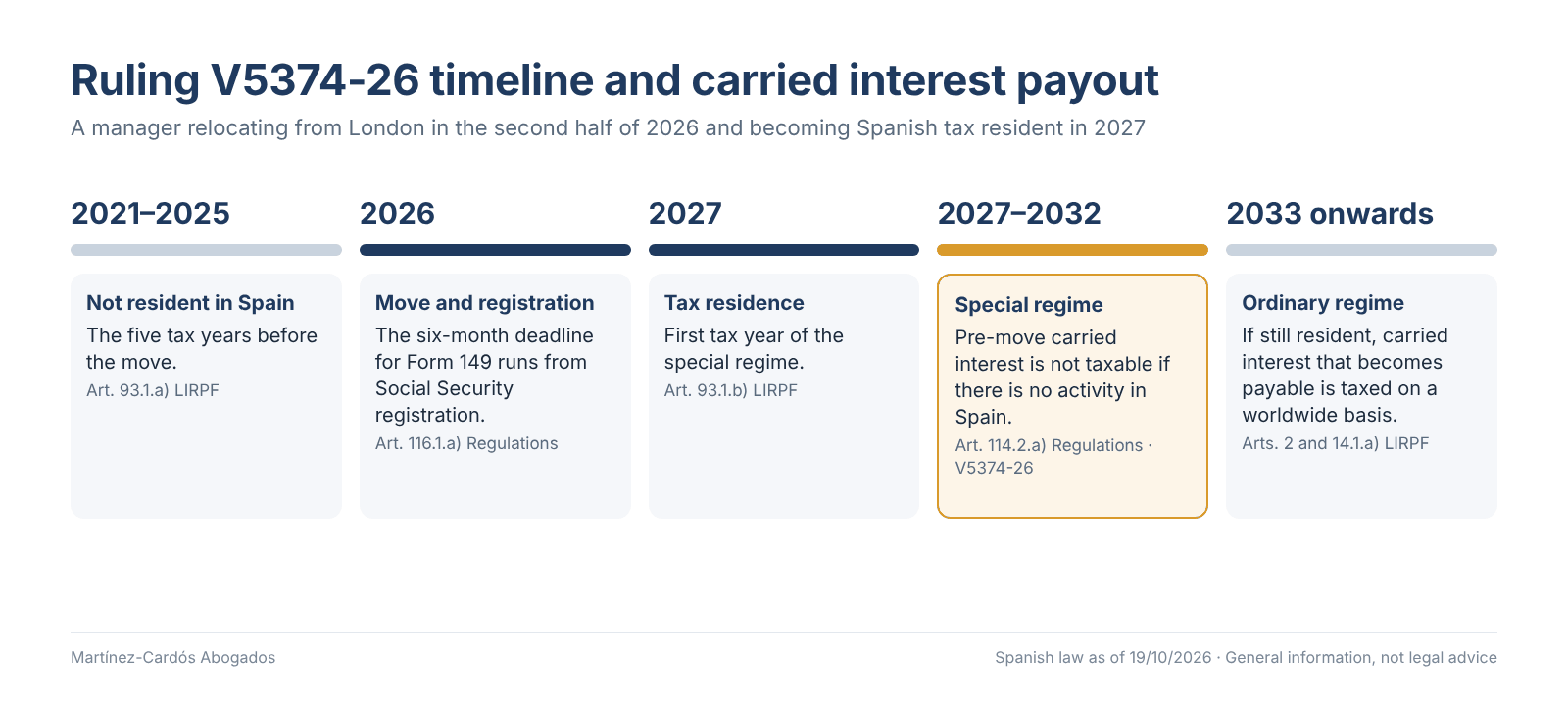
The DGT accepts the regime and rules that pre-move carried interest is not taxable in Spain, provided it does not derive from personal activity in Spain. It assumes he will become resident in 2027, which fits Article 93.1.b) LIRPF: the move may take place in the year before the first year of the regime.
To access the regime, the DGT requires a causal link between the move and the start of the employment relationship with the Spanish company, whose existence it declares outside its remit.
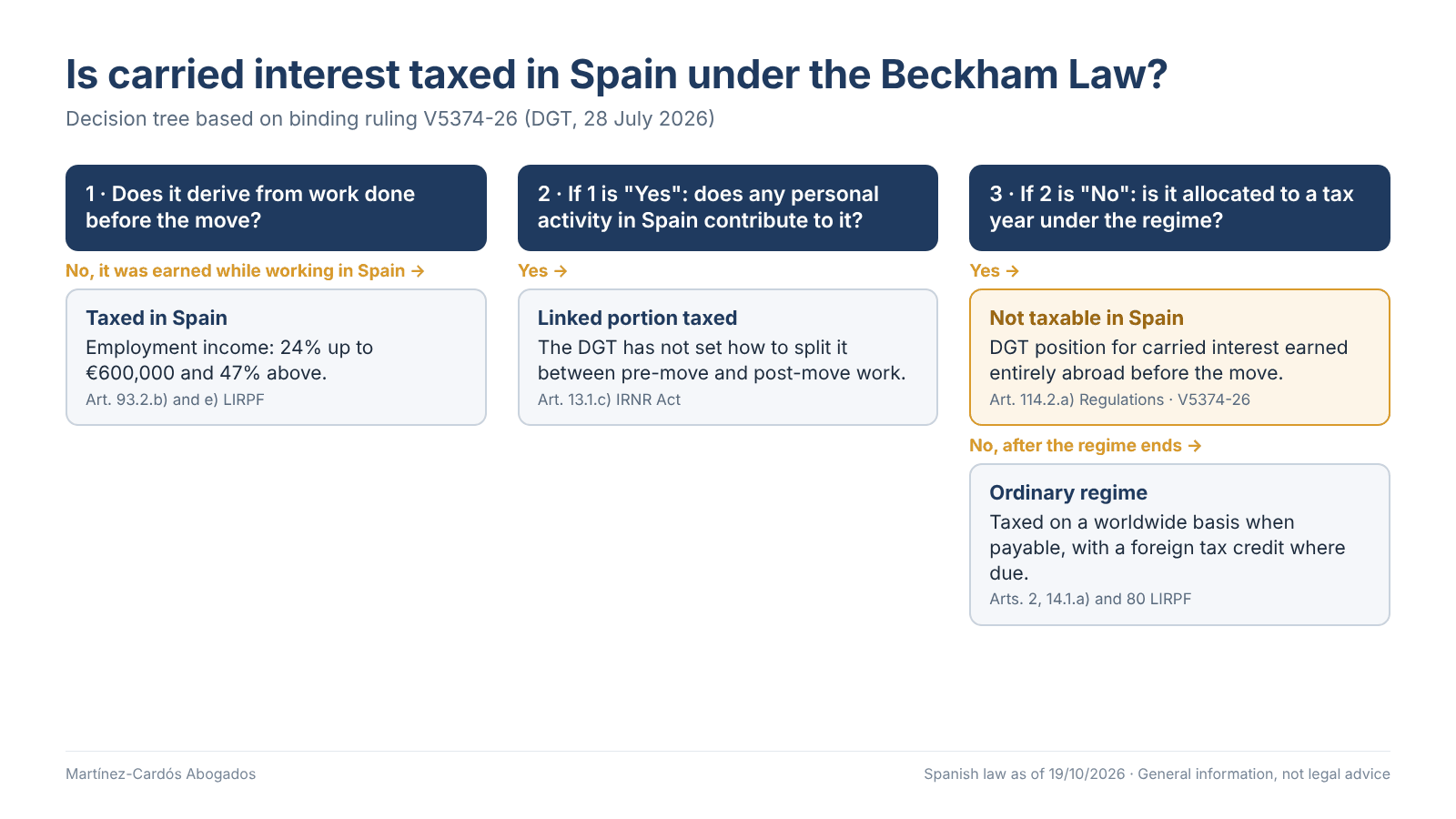
On the carried interest, the reasoning has four steps:
- Premise. The DGT assumes the carried interest is allocated to a tax year in which the taxpayer is under the regime. It does not analyse this; it takes it for granted.
- General rule. Under Article 93.2.b) LIRPF, all employment income obtained during the regime is deemed Spanish-source.
- Exception. Article 114.2.a) excludes income from pre-move work, and the taxpayer states that his carry derives “completely” from such work.
- Referral to IRNR rules. It would only be taxed if Spanish-source under Article 13.1.c). It is not, “to the extent” it does not derive from activity in Spain.
Our view: the right answer, with fine print
We agree with the DGT. Article 114.2.a) exists precisely for these cases, and the ruling is consistent with V1112-25 of 26 June 2025, which held that a 2023 bonus paid in January 2024, after the move, for work done in Israel was not taxable in Spain. What counts is where and when the work was done, not when it is paid. For an industry Spain wants to attract, that certainty is valuable.
Still, the ruling is not a safe harbour for every manager. We see four limits.
1. The facts are very favourable. Passive secondary investments, managed by third parties, with the work finished at closing. In a primary private equity fund, the manager usually sits on boards, designs the value-creation plan and negotiates the exit. If part of that work is done from Madrid, the carried interest no longer derives “completely” from earlier work, and the Spanish Tax Agency (AEAT) may argue that part of it is Spanish-source.
2. Apportionment is left open. “To the extent” invites a split, but the DGT does not say how: by time, by deal or by value created. With no set method, the burden of proof will in practice fall on the taxpayer.
3. Timing matters a great deal. The DGT assumes payment falls within the regime, which lasts six tax years (here, 2027 to 2032). Exits may come later. If the carried interest becomes payable once the manager is under the ordinary regime, Article 114.2.a) no longer helps: a Spanish resident is taxed on worldwide income (Article 2 LIRPF), and employment income is allocated to the year in which it becomes due (Article 14.1.a LIRPF). What remains is the 50% inclusion under Additional Provision 53, if its conditions are met, and the foreign tax credit under Article 80 LIRPF.
4. Plan design counts. A vested right with no continued-employment condition supports the view that the carried interest rewards past work. With a vesting schedule or leaver clauses requiring the manager to stay after the move, the AEAT would have a serious argument that part of it rewards services performed in Spain.
Nor does the ruling address the investment interest, the premium the manager pays into the vehicle from his own funds. Its return is not carry. In our view it keeps its own nature (investment income or capital gain) and, under the regime, would only be taxed if Spanish-source.
How carried interest is taxed depending on when and where it is earned
Under the Beckham Law, carried interest from pre-move work is not taxed in Spain if there is no later activity here. Carried interest earned while working in Spain is taxed as employment income at 24% up to €600,000 and 47% above, under Article 93.2.e) LIRPF. Outside the regime, worldwide taxation applies.
| Scenario | Taxed in Spain? |
|---|---|
| Points allocated before the move, paid during the regime, no activity in Spain | No |
| Pre-move points, but later work in Spain contributes to them | Yes, for the portion linked to that activity; no apportionment method set |
| Points from deals closed while working in Spain | Yes: 24% up to €600,000; 47% above |
| Carried interest payable after the regime ends | Yes, on a worldwide basis, even if from pre-move work |
Example. A manager under the regime receives €1,000,000 of carried interest in 2029, his only general income that year. If it comes from points allocated before the move and there was no activity in Spain, Spanish tax is €0 (the UK position is a separate question). If it comes from deals closed while working in Spain: €600,000 × 24% + €400,000 × 47% = €332,000, an effective 33.2%. For a resident under the ordinary regime, by contrast, Additional Provision 53 would include only half of that amount in the progressive scale, if its conditions are met, so the effective rate could never exceed half of the top marginal rate of the taxpayer’s region.
Does the 50% inclusion under Additional Provision 53 apply within the regime? It is an open question. In favour, Article 24.1 of the IRNR Act sets the gross amount “in accordance with” Personal Income Tax rules, and Provision 53 is not framed as a reduction. Against, the same article excludes reductions, and the regime replaces the Personal Income Tax base with the IRNR base. We have found no DGT guidance for impatriates. In the example, the difference would be €212,000 (€120,000 versus €332,000). We would not apply it without a ruling of your own.
What to review before relocating: steps and common mistakes
Before moving, document which carried interest was earned abroad, separate your Spanish role from earlier investments, and align residence, regime and expected exits. The typical mistake is believing that having the points allocated before the move is enough. It is not.
- List all points, with each deal’s closing date against the date of the move.
- Review the carried interest plan: vesting, continued employment, leaver and clawback provisions.
- Define your Spanish duties in the senior management contract, excluding work on investments with pre-move points.
- Map the calendar: year of residence (more than 183 days, Article 9.1 LIRPF), regime years and expected exits.
- File Form 149 within six months of starting work in Spain (Article 116.1.a of the Regulations).
- If your facts differ from those in V5374-26, request your own ruling.
- Coordinate the UK treatment of your carried interest with UK advisers after the 2026 reform.
Carried interest and the Beckham Law: frequently asked questions
How much tax is paid on carried interest under the Beckham Law?
It depends on its origin. Carried interest earned while working in Spain during the regime is taxed as employment income at 24% up to €600,000 and 47% above (Article 93.2.e LIRPF). Carried interest that derives entirely from pre-move work, with no later activity in Spain contributing to it, is not taxable according to ruling V5374-26.
Can a fund manager on a senior management contract use the Beckham Law?
Yes. Article 93.1.b).1 LIRPF accepts any employment relationship, ordinary or special, except that of professional athletes, and senior management is a special employment relationship. In V5374-26 the DGT accepts it if there is a causal link between the move and the new contract, the manager has not been Spanish resident in the previous five tax years and earns no income through a permanent establishment in Spain.
Can I keep monitoring my pre-move investments from Spain?
The ruling assumes the taxpayer only monitors investments for internal reporting. Anything more (investment committees, portfolio company boards, negotiating the exit) may turn part of the carried interest into Spanish-source income. Keep a record of what you do and from where.
Will the UK still tax my carried interest after I move to Spain?
Possibly, and ruling V5374-26 does not deal with it: it only decides the Spanish position. Since 6 April 2026, the UK has taxed carried interest within its Income Tax framework. Before you move, ask your UK advisers how that regime treats carried interest earned while you worked in the UK, and keep evidence of where each deal was worked.
Does the 50% inclusion for carried interest apply under the impatriate regime?
It is unresolved. V5374-26 does not cite Additional Provision 53, we have found no DGT guidance on impatriates, and Article 24.1 of the IRNR Act supports both readings. For significant amounts, the prudent course is to pay tax on the full amount or request a binding ruling first.
When must I file Form 149 if I move in the second half of 2026?
Within six months of the start date of your activity as shown in your Spanish Social Security registration (Article 116.1.a of the Regulations). If you start working in Spain in 2026, the clock runs from then, even though the regime only applies from 2027, the year you would become resident.
Does V5374-26 apply if my situation is different?
Only to the extent the facts match. The AEAT must apply a ruling’s criteria to other taxpayers where the facts and circumstances are identical (Article 89.1 of the General Tax Act, Ley 58/2003). If your fund is a primary fund, you take part in later management or your plan requires continued employment, request your own ruling before moving.
Conclusion: the origin of the work decides
V5374-26 confirms what the rules already said: carried interest that rewards work done abroad before the move does not become Spanish income because it is paid in Madrid. Good news for managers considering Spain. But its reach is limited to its facts, and the exit calendar may leave part of the carry outside the regime.
If you are planning your move, Martínez-Cardós Abogados can review your carried interest plan, residence timeline and Form 149 before you sign. Book a consultation.